Innovation Time Strategy
Stop sacrificing tomorrow's breakthroughs for today's emergencies by engineering protected time for strategic creativity.
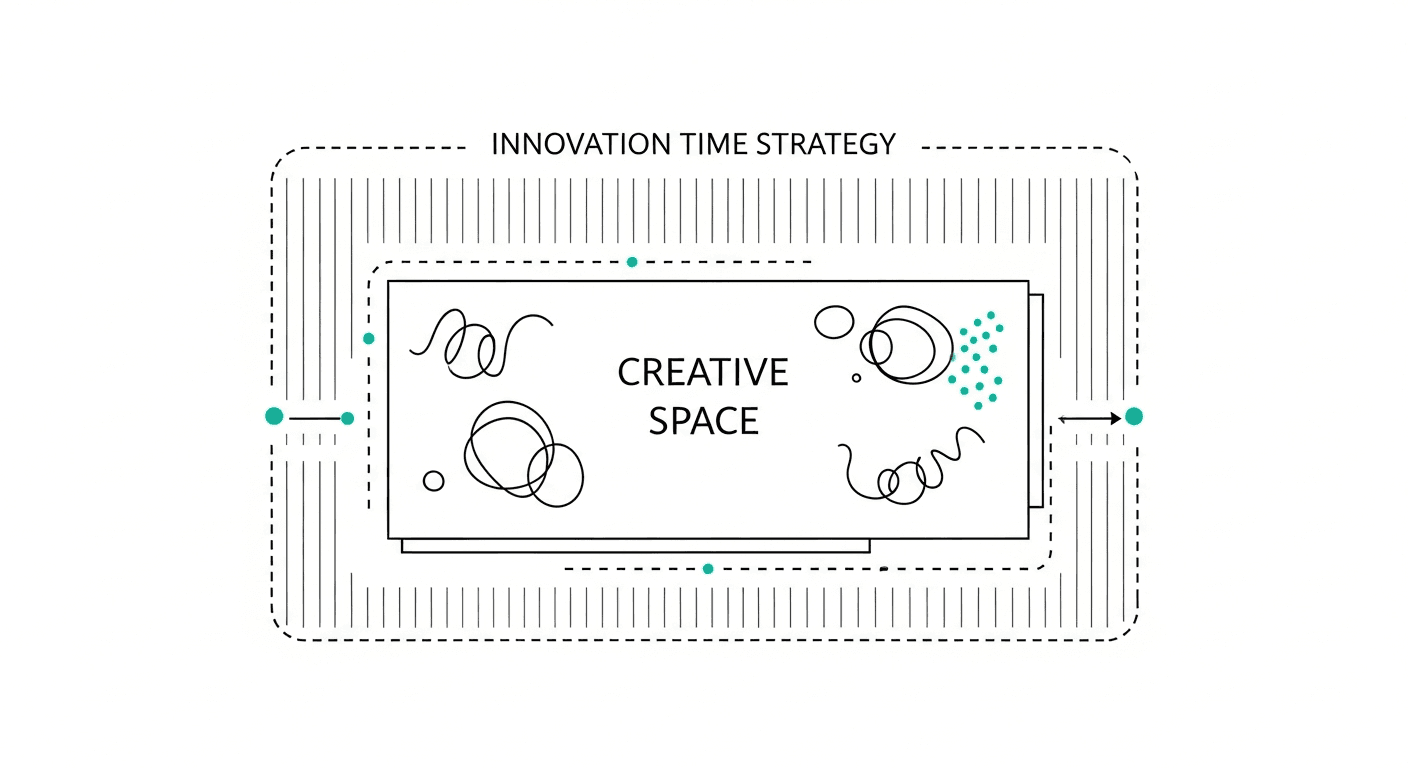
Imagine staring at your quarterly goals and realizing that, once again, your team has hit every operational KPI but hasn't launched a single truly new idea in months. You are not alone in this frustration. Most ambitious leaders find themselves trapped in what we call the "execution treadmill," where the relentless demand of daily tasks, putting out administrative fires, and answering urgent emails consumes every available hour of the workday. We all know conceptually that innovation is the lifeblood of long-term business survival and market dominance. Yet, when we actually look at our executive calendars, the space dedicated to creative, forward-thinking strategy is virtually nonexistent. We are entirely too busy surviving the immediate present to design a competitive future. Operational demands are loud, while innovation is quiet, meaning the urgent will always drown out the important unless we intervene.
This phenomenon happens because operational tasks naturally expand to fill whatever time we allocate to them, leaving deep, unstructured strategic thinking out in the cold. You consistently tell yourself that you will brainstorm that new product feature, revamp that outdated internal process, or explore a new market vertical "when things quiet down." But let us be honest: things never quiet down in a growing business. To break this exhausting cycle, leaders cannot simply hope for a quiet Friday afternoon or an unexpectedly empty schedule; they must ruthlessly engineer it from the top down. Enter the Innovation Time Strategy: a deliberate, structured, and fiercely protected approach to carving out time for creative problem-solving and strategic foresight. By systematizing creativity, leaders can ensure that tomorrow's organizational breakthroughs aren't continuously sacrificed on the altar of today's fleeting emergencies.
The Science
The concept of explicitly blocking out time for innovation is not just a Silicon Valley buzzword; it is a meticulously researched management strategy backed by decades of organizational data. One of the most foundational studies on this topic comes from Harvard Business School professor Teresa Amabile. In her extensive research on workplace creativity, notably the famous "Creativity Under the Gun" study published in the Harvard Business Review, Amabile analyzed over 9,000 daily diary entries from professionals across various industries. Her findings dismantled the popular myth that people are more creative when they are working under strict, high-pressure deadlines. Instead, she found that extreme time pressure stifles the creative process. Professionals were 45 percent less likely to generate a highly creative idea on days when they felt overwhelmed by operational demands. True innovation requires "incubation time"—periods where the brain can connect disparate dots without the immediate threat of a ticking clock or a demanding client.
Furthermore, we can look at the historical precedent set by companies that have successfully institutionalized this practice. The most famous example is 3M's "15% Culture," established in the 1940s, which mandated that researchers spend 15 percent of their time pursuing projects of their own choosing. This specific policy led directly to the invention of the Post-it Note. Google famously adapted this into their "20% Time" policy, which birthed Gmail and AdSense. Management researchers studying these policies note that the effectiveness of the Innovation Time Strategy does not stem merely from the free time itself, but from the psychological safety it provides. When an organization officially sanctions time for unproven ideas, it removes the fear of failure. A study by the Massachusetts Institute of Technology (MIT) Sloan School of Management on corporate innovation found that companies dedicating at least 10 percent of employee time to unstructured exploration reported a 30 percent higher rate of successful new product launches over a five-year period compared to those running at 100 percent operational capacity. The data is clear: if you want sustained innovation, you must budget for it just as rigorously as you budget for your marketing spend or payroll.
The Framework
Implementing an Innovation Time Strategy requires more than just telling your team to "be more creative." It demands a rigid operational framework that protects this time from the inevitable encroachment of daily busywork. Here is how top-tier leadership teams build and maintain an Innovation Time Strategy:
The 80/20 Rule Modification While the traditional Pareto Principle focuses on outcomes, the Innovation Time Strategy applies this to capacity planning. Deliberately staff your teams and plan your sprints so that individuals are only booked for 80 percent of their working hours with standard operational tasks. If your team is operating at 100 percent capacity just to meet baseline goals, innovation is impossible. The remaining 20 percent (or roughly one day a week) must be fiercely protected as a sandbox for strategic thinking, experimentation, and process improvement.
Hard-Coded Calendaring Innovation time cannot be floating or aspirational; it must be hard-coded into the organizational schedule. Leadership should establish specific "blackout blocks" where no internal meetings can be scheduled, and routine communication is paused. Whether this is "Thinking Thursday" mornings or a dedicated two-hour block every Tuesday, this time must be treated with the same reverence as a board meeting or a major client pitch. If an urgent issue arises, the operational default should be to handle it outside the innovation block unless it is a catastrophic emergency.
The "No-Judgment" Output Metric To prevent innovation time from turning into a high-pressure performance test, leaders must separate the time spent from immediate ROI expectations. The framework relies on tracking the input (hours spent exploring) rather than demanding an immediate, profitable output. Employees should be encouraged to present their findings, even if the finding is "this idea completely failed." Celebrating these "intelligent failures" reinforces the framework and encourages bolder, more disruptive thinking rather than safe, incremental tweaks.
Cross-Pollination Sprints Innovation rarely happens in a vacuum. A robust Innovation Time Strategy includes structured periods where individuals from completely different departments collaborate on a problem. Pair a senior software engineer with a frontline customer success representative during an innovation block. This cross-pollination disrupts echo chambers and generates unique solutions to persistent company bottlenecks that neither department could have solved in isolation.
Practical Application
To move from theory to reality, let us examine how different leaders can apply the Innovation Time Strategy in their actual day-to-day environments. Consider a mid-sized B2B marketing agency that was struggling with client churn. The leadership team noticed that account managers were so busy executing monthly deliverables that they never had time to pitch proactive, out-of-the-box campaign ideas. The CEO implemented a mandatory "Innovation Friday" from 9:00 AM to 12:00 PM. During this three-hour window, the agency's internal communications were paused, and no external client meetings were allowed. Account managers used this time to research emerging industry trends, play with new marketing tools, and brainstorm campaigns for their clients that were entirely outside the current scope of work. Within two quarters, not only did client retention increase by 22 percent because clients felt they were receiving proactive strategic partnership, but the agency also successfully upsold three major accounts on new service packages that were entirely conceived during the Friday blocks.
Another practical example is found in the operations of a fast-growing digital product startup. The CTO realized that technical debt was slowing down their release cycles, but the development team was too swamped with feature requests to fix the underlying architecture. They instituted an "Innovation Sprint" strategy. Every sixth week, the entire product team paused standard feature development. Instead, developers had complete autonomy to spend that week working on any project that would improve the codebase, enhance the user experience, or automate a tedious internal process. One junior developer used this time to build an automated testing script that ended up saving the entire engineering team four hours a week in manual QA testing. By taking a short-term pause on operational output, the startup massively accelerated its long-term velocity. These examples demonstrate that innovation time is not a luxury for tech giants; it is a practical, scalable strategy for any team willing to enforce the boundaries required to make it happen.
High-Performer Takeaway
The ultimate competitive advantage in modern leadership is not how fast your team can execute, but how consistently you can carve out the space required to evolve. The Innovation Time Strategy shifts your organizational posture from constantly reacting to proactively designing. However, the greatest enemy of dedicated innovation time is the friction of capturing ideas and managing the operational tasks that inevitably pop into your head while you are trying to think strategically.
This is where a Universal Productivity Platform like Hello Aria becomes an indispensable asset for high-performing leaders. When you are deep in a dedicated innovation block or on a strategic walking brainstorm, you do not want to break your creative flow by opening a complex application to log an unrelated operational task. Just message Aria on WhatsApp—"Remind me to email Sarah at 4 PM about the Q3 budget"—and it's captured in your built-in Aria todo list instantly, no phone unlocking or app switching needed. You can use Aria's voice-to-text feature to securely dump your raw, unstructured innovation ideas into your notes without staring at a blank screen. If you are running a Cross-Pollination Sprint, you can easily use Aria's "Circles" feature to coordinate with the team and set automated follow-ups for your innovation milestones. Furthermore, any strategy sessions tied to Google Meet, Microsoft Calendar, or Gmail can be seamlessly managed from your unified dashboard. You can even generate instant WhatsApp meeting notes and actionable summaries from your team's collaborative voice notes. By letting Hello Aria handle the relentless operational noise across all your devices, you finally secure the uninterrupted time your team needs to innovate and lead your industry.