Zettelkasten Method Explained
Stop hoarding information and start building an external brain that generates ideas for you.
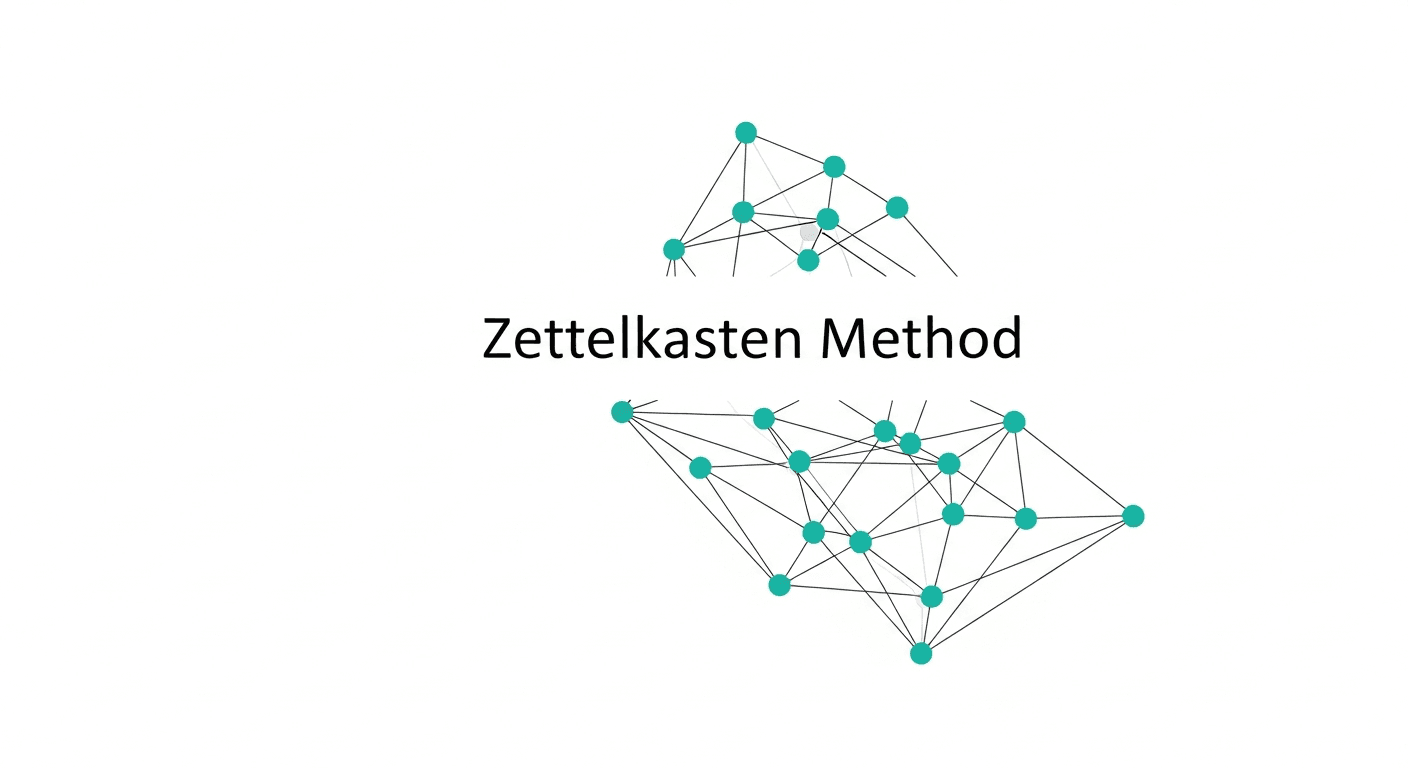
We have all been there. You read a groundbreaking book, highlight the best passages, and perhaps even scribble some enthusiastic margin notes. You feel smarter. You feel like you have absorbed the material. Fast forward three months: you remember reading the book, you remember enjoying it, but you cannot recall a single actionable insight or how it connects to the project you are working on right now. Your notes are trapped in a silo—or worse, forgotten in a digital graveyard of abandoned documents.
This is the "Collector’s Fallacy," the mistaken belief that merely collecting information is the same as acquiring knowledge. We hoard articles, save bookmarks, and stack books, assuming that the sheer volume of consumption equates to intelligence. But information is useless unless it is processed, synthesized, and retrievable when you actually need it. The solution to this intellectual bottleneck isn't a better filing cabinet; it is a completely different way of thinking about how ideas interact. Enter the Zettelkasten method—a system designed not just to store notes, but to make them talk to each other.
The Science: The External Brain of Niklas Luhmann
The Zettelkasten method (German for "slip-box") gained mythical status thanks to the sociologists Niklas Luhmann. Luhmann wasn't just productive; he was prolific on a scale that defies explanation by standard metrics. Over his nearly 40-year career, he published more than 70 books and 400 scholarly articles. When asked about his secret, he didn't credit his intellect or his work ethic. He credited his box.
Research into cognitive science supports the efficacy of Luhmann's approach. This touches on the concept of Extended Cognition, a thesis proposed by philosophers Andy Clark and David Chalmers. They argue that cognitive processes are not strictly bound by the skull but can extend into the environment through tools. Your smartphone, your notebook, and your Zettelkasten are literally parts of your functional cognitive apparatus. By offloading the storage and retrieval function to a reliable external system, you free up working memory for higher-order processing, synthesis, and creativity.
Furthermore, the method leverages the Elaboration Likelihood Model. Simply highlighting text is a passive activity with low retention. The Zettelkasten forces you to translate raw inputs (what you read) into your own words (what you understand). Studies in educational psychology consistently show that this process of "elaboration"—rewriting an idea in your own context—dramatically increases retention and understanding. Luhmann’s slip-box wasn't an archive; it was a conversation partner that surprised him with connections he hadn't explicitly made, effectively creating a "second brain" that compounded in value over time.
The Framework: Principles of the Slip-Box
Transitioning to a Zettelkasten requires unlearning the hierarchical way we are taught to organize files. There are no folders here. There is no top-down structure. Instead, the system relies on atomic notes and organic links. Here are the core components:
-
Fleeting Notes: These are the sparks of inspiration that hit you while you are washing dishes, walking the dog, or in the middle of a meeting. They are temporary. They are meant to be captured quickly before they vanish. You do not worry about grammar or format here; the only goal is capture. These are later processed or discarded.
-
Literature Notes: When you consume content (books, podcasts, articles), you create Literature Notes. These are summaries of the content in your own words. You must be very selective. Do not copy-paste quotes. Write down the bibliographic info and a concise summary of the points that resonate with you. This forces you to verify that you actually understand the material.
-
Permanent Notes (The Zettels): This is the heart of the system. You take your Fleeting Notes and Literature Notes and process them into Permanent Notes. A Permanent Note must be Atomic (containing only one single idea), Autonomous (understandable on its own without context from the book it came from), and Linked. You write these as if you are writing for someone else, with full sentences and clear logic.
-
The Index and Links: In a traditional notebook, page 5 comes after page 4. In a Zettelkasten, notes are connected by content, not chronology. If you write a note about "Compound Interest," you might link it to a note about "Habit Formation" because both deal with exponential growth over time. These lateral connections are where the magic happens. Over time, clusters of notes form around themes, revealing outlines for articles or projects you didn't even know you were researching.
Practical Application: Building the Web
How does this look in the real world? Let’s strip away the theory and look at the workflow of a knowledge worker using this method.
Phase 1: The Capture Imagine you are listening to a podcast about biology and you hear an interesting fact: "Trees communicate via underground fungal networks." You don't have time to write an essay, so you grab your phone. You need a capture tool that is frictionless. You jot down: "Trees/fungal networks/communication similarity to internet."
Phase 2: The Elaboration Later that evening, or perhaps during your weekly review, you look at that fleeting note. You decide this is an idea worth keeping. You open your Zettelkasten (whether digital or analog). You write a new Permanent Note. You title it: "Mycorrhizal Networks as Nature's Internet."
In the body of the note, you explain the concept clearly: Trees are not solitary individuals; they share resources and distress signals through fungal networks in the soil, creating a symbiotic relationship often dubbed the Wood Wide Web.
Phase 3: The Connection This is the critical step. You don't just file it under "Biology." You look at your existing notes. You find a note you wrote three months ago about "Decentralized Data Structures in Tech." You realize the structure of the fungal network is similar to a peer-to-peer network. You add a link between the two notes. You find another note about "Altruism in Nature" and link it there too.
Phase 4: The Output Six months later, you are asked to write an article about the future of the internet. You open your Zettelkasten. You don't face a blank page. You follow the trail of links starting from "Decentralized Data Structures." You find the link to the fungal networks. Suddenly, you have a unique angle for your article: comparing blockchain to forests. The article basically writes itself because the arguments are already developed in your Permanent Notes.
High-Performer Takeaway
The Zettelkasten method shifts your workflow from "Consumer" to "Creator." The biggest friction point for most people, however, is the very first step: Fleeting Notes. If capturing the idea is difficult, you won't do it, and the system starves.
This is where Hello Aria becomes your competitive advantage. You do not need to open a heavy note-taking app just to capture a fleeting thought. Since Aria lives where you already communicate, you can capture ideas instantly without breaking your flow.
When a thought strikes you during a commute, simply open WhatsApp and send a voice note to Aria: "Note: The Zettelkasten method is basically compound interest for knowledge." Aria’s voice-to-text feature will transcribe this and save it directly into your dashboard. Later, when you are ready to process your notes into the Permanent stage, you can view all your captured items in the Aria dashboard or ask Aria to remind you to "Process fleeting notes" at 5:00 PM. Aria’s built-in reminders ensure that your captured insights are never lost to the void, bridging the gap between a fleeting thought and a permanent idea.